Papadiamantis House Museum
In the heart of the town, close to the harbour, stands the home of Alexandros Papadiamantis, the great Greek short-story writer of the 19th century. His father built the simple stone house, and the writer grew up and died here. A listed monument and now a museum, its upper floor keeps the family rooms with original furniture and his pen, inkwell and chanter's stand, while the ground floor shows editions of his work. Admission EUR 1.
Bourtzi Peninsula
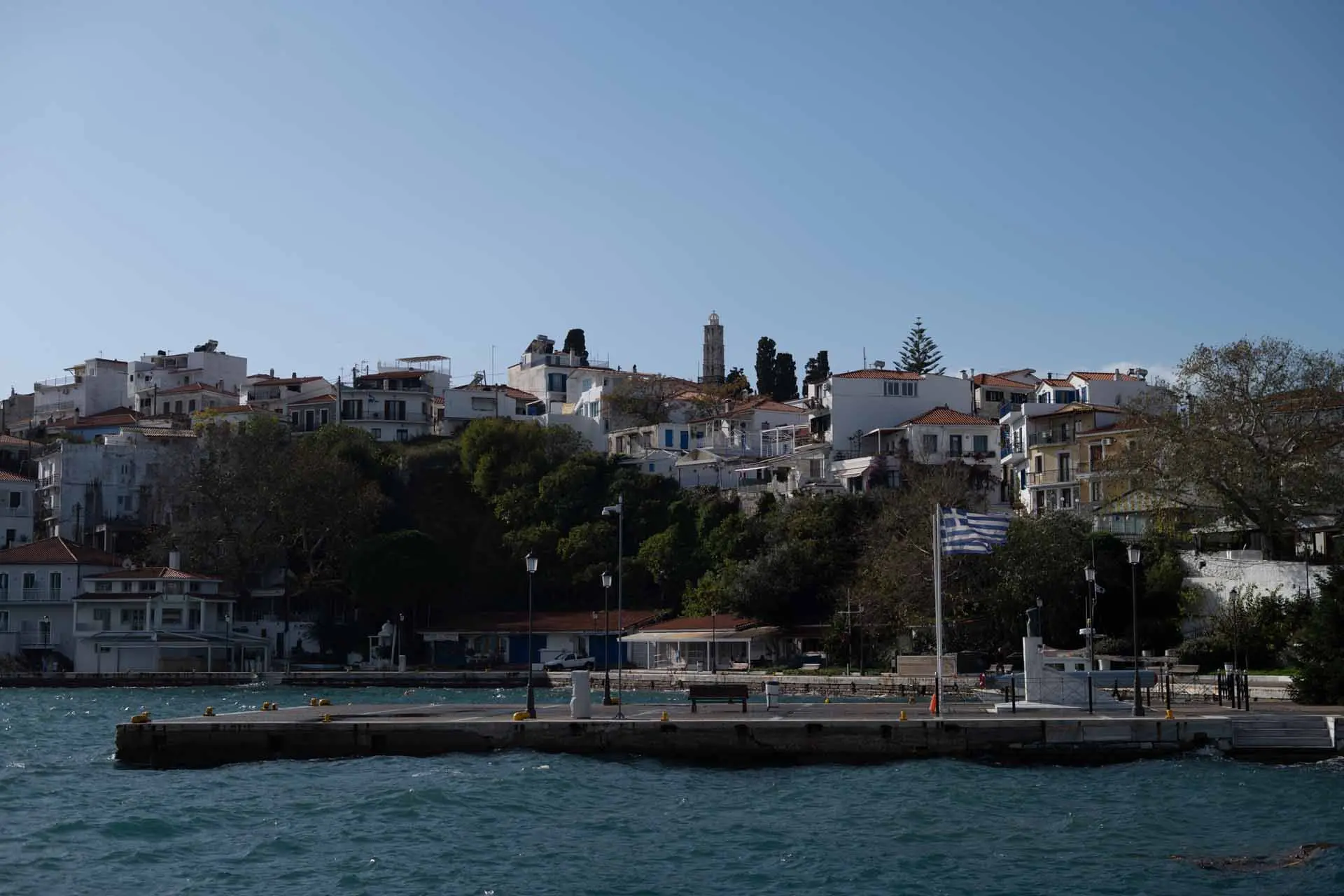
The pine-covered Bourtzi peninsula divides the Old Port from the new port, a few minutes' walk from the tender landing. Its early 20th-century building, once the island's first primary school, now houses the Museum of Maritime and Cultural Tradition, whose collection of more than 600 exhibits tells two centuries of shipbuilding and seafaring on Skiathos, with a section on the submarine Lambros Katsonis, sunk off the island in the Second World War. Shaded paths lead to viewpoints over both harbours and the town on its two hills.
Evangelistria Monastery
Founded in the late 18th century by the hieromonk Niphon, who came from Mount Athos, the Monastery of the Annunciation, known as Evangelistria, stands among pines and olive trees in the hills just outside the town. The first Greek flag with a white cross on a blue background was woven and raised here, and fighters of the War of Independence swore their oath in its church. Its museum keeps manuscripts, vestments and the loom used for the flag, and the monks sell their own wine, olive oil and honey. Entry is free.
Koukounaries Beach
The most famous beach on Skiathos lies on the south-west of the island, where a tall pine forest runs down to fine golden sand and a Blue Flag sea. The beach is organised, with water sports, boat hire and diving nearby, and tavernas and cafes behind the shore. Behind the forest is Strofylia lagoon, a protected Natura 2000 wetland. Koukounaries is the terminus of the main bus line from the town, and its western end is a fine spot for the sunset.
Kastro
In the 14th century, to escape pirate raids, the islanders left their coastal town and built a new one on Kastro, a rocky headland on the north coast that rises sheer above the sea. Strong walls with cannons guarded the land side, reached by a wooden drawbridge, and a few churches, among them Christos sto Kastro with its wall paintings, still stand among the ruins. The easiest way there is by excursion boat from the Old Port to the small beach below; by road, the drive ends before the site and the last part, about half an hour, is on foot.
Lalaria Beach
On the north-east coast, below steep white cliffs, Lalaria beach is covered with smooth, round white pebbles, the lalaria that give it its name, washed by clear turquoise water. A natural arch in the rock, Trypia Petra, frames the shore. The beach can be reached only by sea, on the daily boats from the port of Skiathos when the sea is calm. It has no facilities, landings are controlled to protect it, and taking pebbles is forbidden.