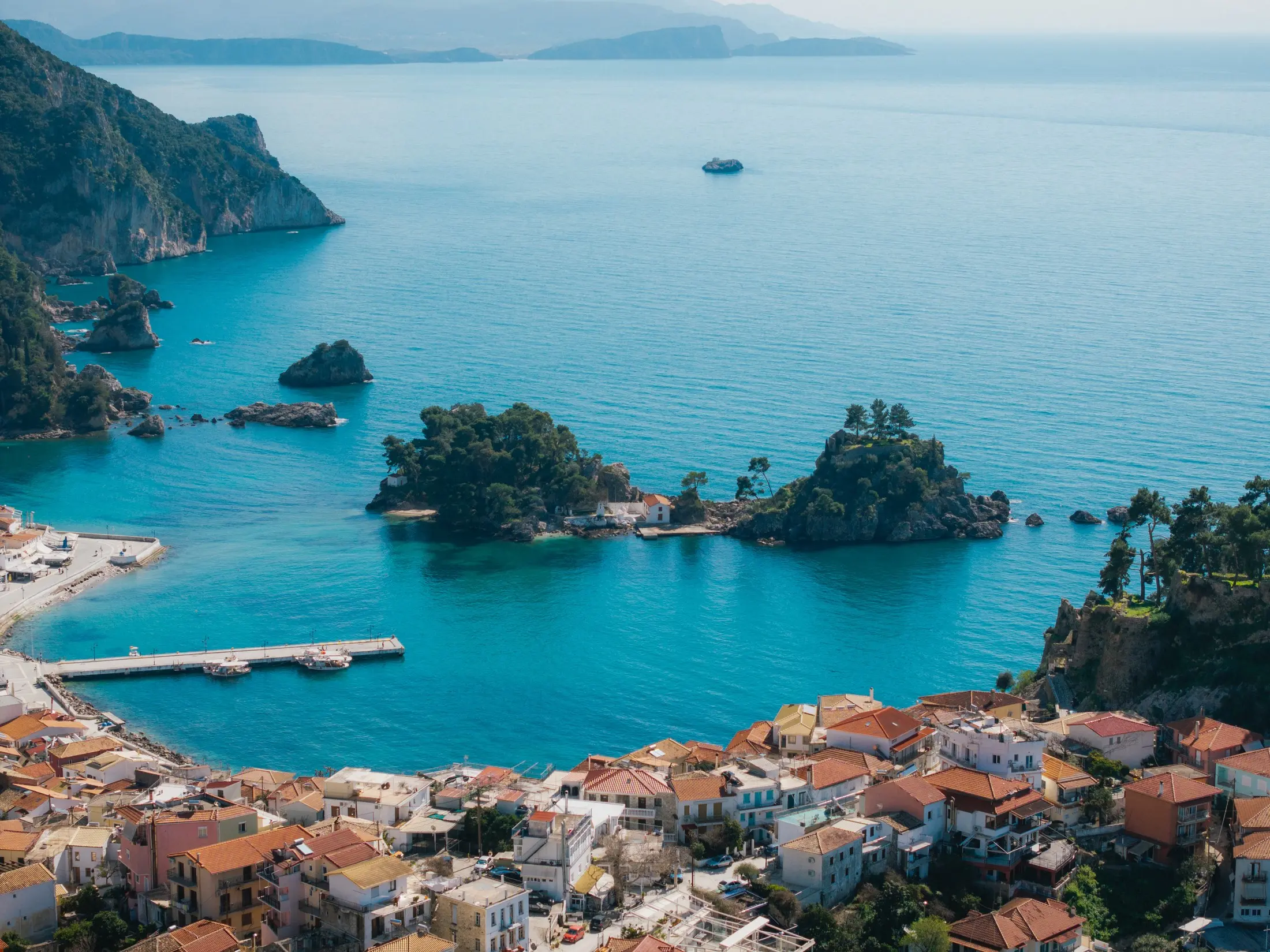
Parga Castle
The castle crowns the rocky headland between the harbour and Valtos beach, its walls following the edge of the cliffs. Parga placed itself under Venetian protection and served for four centuries as a Venetian outpost on the Epirus coast; the fortress was burned by Ottoman fleets and owes its present form mainly to later Venetian rebuilding. When the town was handed to Ali Pasha, most Pargians left for Corfu, and he added a polygonal citadel at the top of the hill. Entry is free, and the walk up through the old town ends at views over the bay and the Panagia islet.
Anthousa Castle (Ali Pasha Castle)
On a steep hill above the villages of Anthousa and Agia, about 6 km from the harbour, stands the fortress Ali Pasha of Ioannina built to besiege Parga, then under French and later British protection. Its monumental west gate is flanked by two towers, and a 15 m bastion-tower facing Parga held the gun batteries that could reach the town 1,200 m away. It lost its purpose only a few years later, when Parga was handed to Ali Pasha. The site gives wide views of the coast; a trail also climbs here from Valtos beach past the Anthousa waterfall and old watermills.
Necromanteion of Acheron
At Mesopotamos, about 20 km south of Parga where the Acheron and Cocytus rivers meet, the Necromanteion was believed to be a gateway to the Underworld, linked in the Homeric epics with Odysseus' visit to the seer Tiresias. From the Mycenaean to the Hellenistic period it was a place of rituals to consult the dead. Visitors explore a stone complex with underground rock-cut chambers and a vaulted hall of fifteen arches known for its acoustics, beneath the monastery of St John the Baptist. Tickets EUR 10, reduced EUR 5.
Acheron River Springs
Inland, about 2 km from the village of Glyki, the clear waters of the Acheron, the mythical river of the Underworld, emerge from the mountains of Souli and run through gorges shaded by old plane trees. The area is protected under Natura 2000. An easy trail leads from the Glyki information centre to Skala Tzavelena, and a longer hike follows the gorge past the arched Dala bridge to the narrows known as the Gate of Hades. When the river can be waded, it is also popular for rafting, kayaking and horse riding.